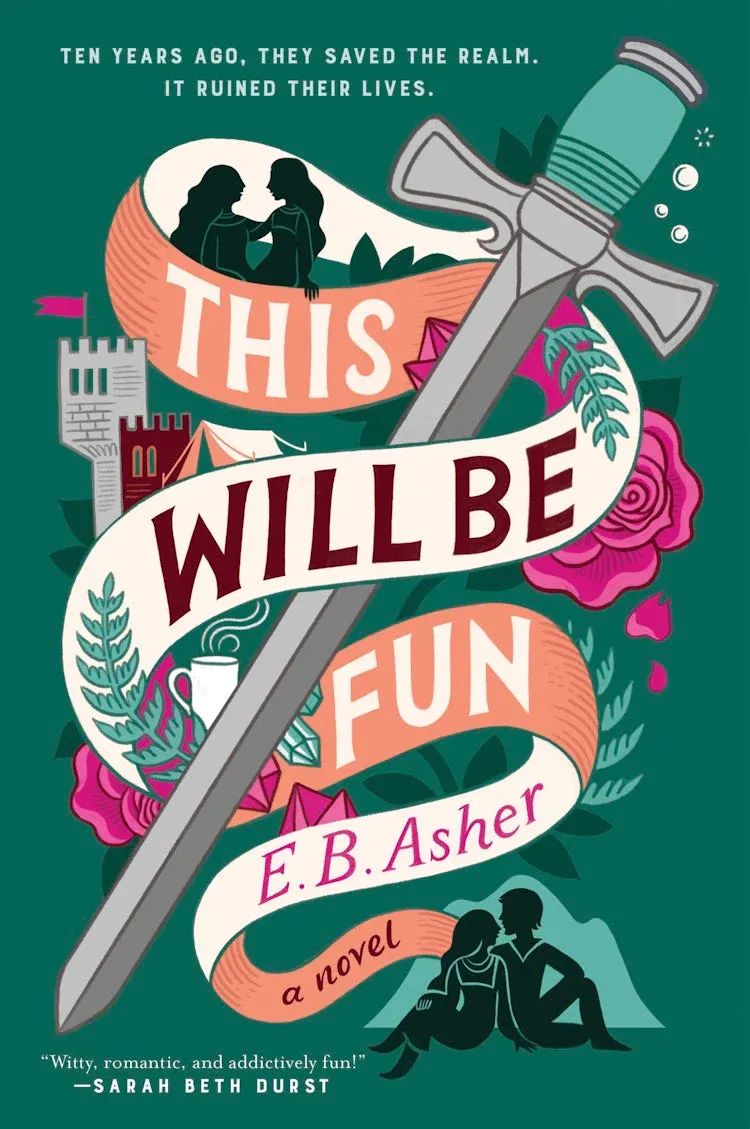
Author: E. B. Asher
Published: 2024
Target audience: Adults (appropriate 17+)
When a book comes with recommendations from romantasy author Sarah Beth Durst, award-winning literary novelist Jodi Picoult, and a screenwriter of ‘Shrek’, how could you not check it out? Welcome to be ‘This Will Be Fun’, a tale of how life goes on after the quest is won, and life gets messy.
Everyone in Mythria knows the story of how valiant leader Galwell the Great, best friends Beatrice and Elowen, and handsome ex-bandit Clare saved the realm from darkness. It’s a tale beloved by all—except the former heroes. They haven’t spoken in a decade, devastated by what the quest cost them.
But when they receive an invitation to the queen’s wedding, it’s a reunion rife with wounds never healed and romances never forgotten. Clare’s not over his long-ago fling with Beatrice, Beatrice is beset by guilt over how everything ended, solitary Elowen is unprepared for the reappearance of her former flame Vandra, and all of them are floundering without Galwell. And if a fractious reunion wasn’t perilous enough, dark forces have returned with an evil plot that only Mythria’s one-time heroes can stop. Maybe.
Ten years ago, they saved the realm and it left them broken. This time around, will their story end in happily ever after?
From a trio of authors writing under the pseudonym E. B. Asher, ‘This Will Be Fun’ promises a lively tale of lovelorn heroes, carnivalesque quests, and what happens after the day is saved. Such a premise has great potential, and ‘This Will Be Fun’ stands out as a lighthearted, rom-com addition among contemporaries exploring similar plots including ‘Chosen Ones’ by Veronica Roth, ‘Slayers of Old’ by Jim C. Hines, and Stephen Aryan’s ‘The Coward.’
I wanted to badly to enjoy this book. ‘This Will Be Fun’ has a cheery, tongue-in-cheek approach to world-building with entertaining magical versions of coffee shops, video calls (conjurations), instant messaging (scribing on message tapestries), and ride shares (just recite the simple summoning spell for Wagons-For-You!). Unfortunately, the romance is where this romantasy novel falls short. Any chance of becoming invested in the relationship between Elowen and Vandra or Clare and Beatrice is undermined by pervasive plot contrivances and characters constantly violating the autonomy and personal boundaries of their love interests.
Throughout the book’s first half, Elowen repeatedly says she does not want to go with Vandra to the queen’s wedding, yet gives in as she knows she can’t outwit or outrun the former assassin sent to fetch her. The story frames this a whimsical interaction with Vandra gasping in delight, saying “You’re really letting me kidnap you?” and Elowen ruefully agreeing. However, removal of a character’s agency is capitulation, not willing consent. Elowen does not have the option to escape or refuse, and Vandra directly tells Elowen that she won’t let her get away. This unequal dynamic persists throughout ‘This Will Be Fun’ with multiple further instances of Vandra deliberately disregarding Elowen’s boundaries:
- Vandra knows Elowen’s magic causes her to experience the emotions of those she touches. So when Vandra coerces Elowen to get on a horse with her, Elowen has to hold onto Vandra and is bombarded by the other woman’s good mood. Only hours later when they dismount and separate is Elowen able to feel her own genuine emotions of resentment, anger, and betrayal again.
- Elowen insists she wants to eat alone in her room at the inn, but Vandra just laughs and says Elowen has to either let Vandra into her room to eat together, or Elowen has to come with Vandra to the tavern for dinner.
- Elowen begs for a moment of privacy, and instead Vandra intrudes on Elowen’s session with her therapist.
All these things are framed by the novel as being good for Elowen to be out in society again, as well as the perfect opportunity to reconnect with her former lover. The narrative insists that this dynamic is cute and healthy, with Elowen and Vandra acting amorously towards each other. On the other hand, there is an inherent power imbalance between the characters and repeated violation of Elowen’s wishes. The irreconcilability of these elements evokes a sense of cognitive dissonance, and can make for an unpleasant reading experience.
In comparison, Clare and Beatrice’s interactions are not as unequal, but are still marred by contrivance and moral trespass. Their reunion become tiresome as the plot clumsily shoves Clare and Beatrice together again and again. They bump in to each other at Beatrice’s ex-husband’s mansion when she sneaks in to steal back her bathrobe. They bump into each other the next morning at the fantasy equivalent of Starbucks. And they bump in to each other again on the road during a bandit attack, after which Clare annoys Beatrice so much that she agrees to ride with him to shut him up. One contrived meeting would be fine, but the repeated use of this set up makes for a frustrating reading experience as it strips the characters of their agency and choice.
After all four characters bump into each other at a tavern, Vandra and Clare (who are both already inflicting their presence on their unwilling travelling companions) unilaterally decide that the four of them should travel en masse, declaring that it would be good for Elowen and Beatrice to reconnect after their fall out ten years ago. Yet again, Vandra and Clare trample on Elowen and Beatrice’s boundaries by paternalistically assuming they know what’s best and making decision without Elowen or Beatrice’s knowledge, input, or consent. To implement this plot, Vandra and Clare pretend that their horses were stolen, necessitating that the four continue onwards in the same carriage. These decisions paint Clare and Vandra as manipulative and controlling, and may encourage audiences to hope that they don’t get together with their love interests or are revealed to be villains later, thus recontextualising their actions.
This adverse image of Clare continues with him later deliberately barging in on Beatrice while she’s in the bath to trap her in conversation. Even after she explicitly tells him to get out, he stays to pressure Beatrice into going on a quest she has already refused. The novel once again tries to convince readers that Clare’s violation of Beatrice’s privacy is a charming opportunity for flirting and bonding between the two. However, when Beatrice (who is trapped in a vulnerable position with a man who refuses to listen) starts responding coquettishly, it comes across as odd, inauthentic, or perhaps ‘fawning’ - a trauma response alongside ‘fight’, ‘flight’, and ‘freeze’ used to survive threatening scenarios by trying to placate or win over their aggressor. Advice to romance writers: If your flirting scene with the love interests makes your readers think of trauma response tactics, maybe re-write the scene.
The book does improve in the second half. There is a clear goal for the characters to pursue, challenges requiring them to cooperate, and a side character named Hugh who is a delight every time he shows up. It is unclear, however, if the second half is better due to improved pacing and more natural character interactions, or the result of me lowering my standards, and then lowering them again. Despite these improvements, the book does manage to the insult the audience one last time by having the day saved by a never-before-mention magical solution that comes out of nowhere, with absolutely no foreshadowing.
I highly recommend reading ‘This Will Be Fun’ if you would like to study how an author can botch their rom-com by trying convince their audience that toxic, manipulative partners are romantic and desirable. For any other reason, don’t waste your time.
