Author: Alexandria Warwick
Published: 2022
Target audience: Adults (18+)
THIS REVIEW CONTAINS MINOR SPOILERS
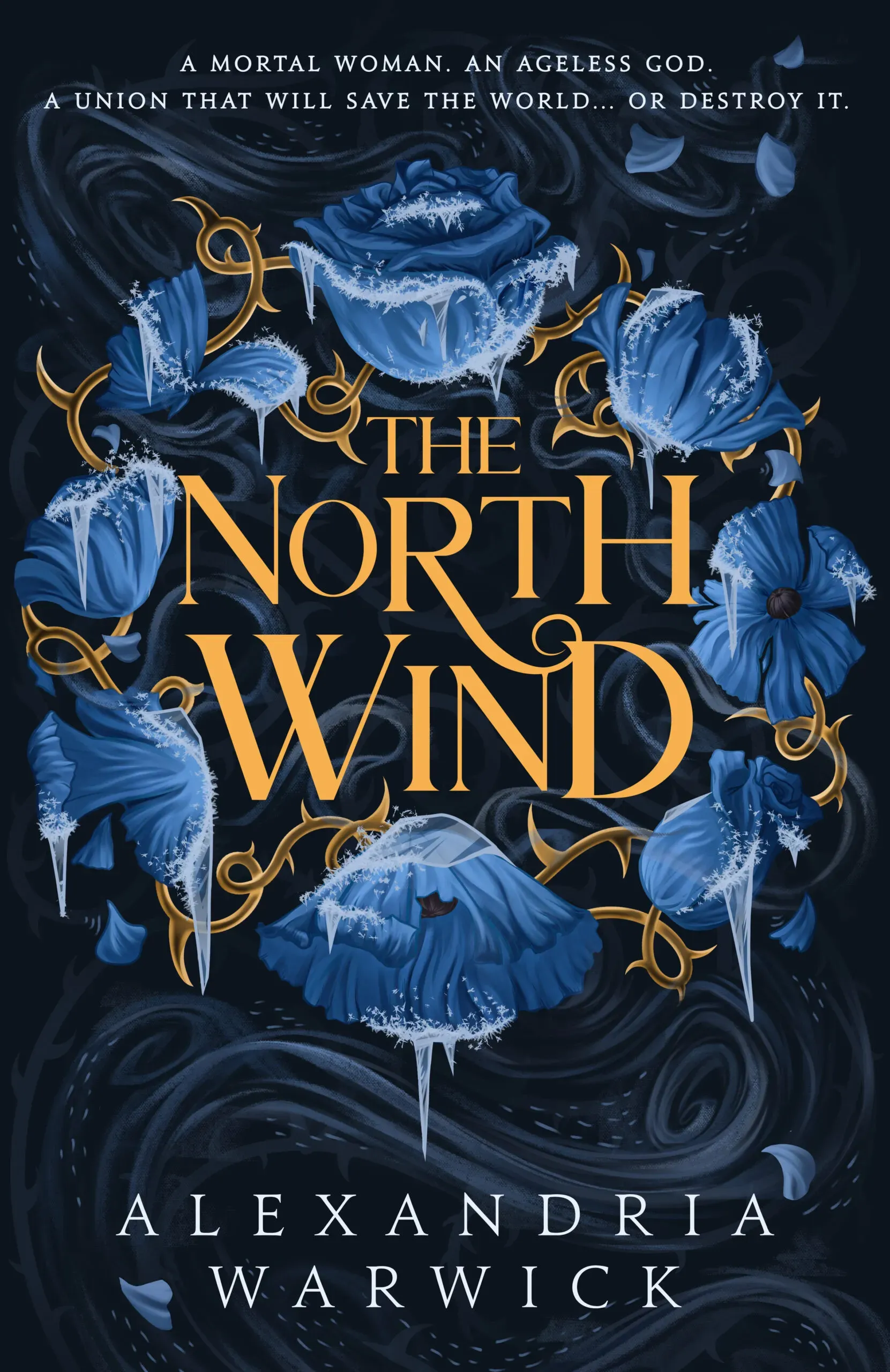
With a beautiful cover and a promise of more books to come, ‘The North Wind’ is an adult romantasy novel marketed as a lush and darkly enchanting tale for fans of Sarah J. Maas, Jennifer L. Armentrout, and Scarlett St. Clair. Combining elements from beauty and the beast with Hades and Persephone, ‘The North Wind’ is a slowburn love story between a powerful god and a mortal women determined to protect her sister.
First published in 2022, ‘The North Wind’ is the first in the ‘Four Winds’ series - a quartet of standalone novels with interlocking mythology-inspired romance stories. This book follows a young woman called Wren who takes her sister’s place to spare her from being forced into marrying the North Wind - a dangerous immortal who is said to be as cold and uncaring as the frozen land he rules. Many readers have pointed out similarities between ‘The North Wind’ and American author Sarah J. Maas’ 2015 hit novel ‘A Court of Thorns and Roses,’ with both female main characters being archers with sisters they care for, a weakening magical barrier, seasonal lands, the male main character seeking a wife, beauty and the beast influence, and more. Both books also start with the protagonist hunting a deer/elk through a frozen forest, with ‘A Court of Thorns and Roses’ opening line being “The forest had become a labyrinth of snow and ice”, and the first chapter in ‘The North Wind’ containing the line “The forest, a labyrinth of snow and ice, seems to shudder around me.” Despite similarities, a novel’s success or failure rests on its own merit and execution, irrespective of parallels or inspiration from other books.
Unfortunately, in this case, there are a multitude of factors which render ‘The North Wind’ unremarkable and unengaging. The novel’s writing is the same uninspired, thesaurus-raiding style found in the plethora of BookTok romantasy books being churned out to meet algorithm-dictated demand: Characters ‘wend’ to destinations, ‘growl’ their lines, and constantly yo-yo between melodramatic generic fantasy dialogue and modern vernacular. There is a checklist of popular romantasy tropes (enemies-to-lovers, there’s only one bed, arranged marriage, mythology-retelling, etc) plopped in the story without effective implementation or understanding of what makes these tropes work. Multiple plot lines and world-building elements are introduced only to be dropped, unexplained, or later contradicted. The ‘slowburn love story’ could be more aptly described as poorly-paced and lacking credibility. Furthermore, like too many others in this genre, this book propagates the message that falling for a violent, cruel man who strips women of their agency is romantic and desirable. However the story’s core failing is the character of Wren - a wannabe-badass protagonist who is the epitome of every bad ‘strong female character’ cliche ever.
Wren’s motivation of wanting to save her sister and town is clearly established and commendable, but her proposed plans are ill-conceived and conflicting. She asserts that her people suffer and starve because Boreas, the North Wind, inflicts an eternal winter on the land, and that the only way to end his ruinous reign is to kill him. However, Wren is also completely aware that Boreas is the one who maintains the barrier between the mortal world and the Deadlands - this barrier being the only thing preventing the ravenous undead from breaking into the living world and devouring everyone Wren knows. Yet despite being aware of this, she is determined to kill him anyway, consequences be damned. Her conviction is illogical and idiotic, and may leave readers scratching their heads at the contradictions.
Such discrepancies are not just limited to her goals. Wren’s actions and mentality do not mesh with her supposed humble town upbringing and the Greek mythology-infused world she inhabits. Why is she surprised to learn that her new husband - who she knows is an immortal god and the literal embodiment of the north wind - is thousands of years old? Why does she think and speak like someone living in the 21st century? Her personality would make more sense if she was someone from our world who has been transported into a fantasy land. Instead, her characterisation falls into the same tired tropes of trying to create a ‘strong female character’ for modern audiences: Wren is snarky, headstrong, self-aggrandising, goes hunting, read smutty books, wields daggers, is quick to physically fight, and the only female character to take any action while other women are portrayed as submissive, passive, and forgettably interchangeable. It is certainly possible to write a compelling character with these traits.‘The North Wind’ , however, does not succeed in this aspect.
Instead, Wren is simply an unlikeable and unenjoyable protagonist. Despite coming from poverty herself, Wren orders servants around and insists that people obey her as queen. She is inherently a free-roaming prisoner, and only much later does this status tacitly change when a more intimate relationship develops between Wren and Boreas. Despite being ignorant of the customs and workings of the Deadlands, Wren presumes that she knows the hearts and intentions of Boreas’ subjects better than him. She demands Boreas spares her kidnapper from punishment on the basis that the kidnapper did not know what he was doing, despite the kidnapper literally just telling her that he knew exactly who she was and that he deliberately took her to use against the North Wind.
There are multiple other instances where she argues against Boreas’ decisions in what appears to be an attempt to present Boreas as cold-hearted and unjust and thus depict Wren as virtuous and empathetic in comparison. However, Wren’s actions and opinions are distinctly at nonsensical odds to the world and events around her, and often bring negative consequences upon herself and others. Examples include Wren demanding her maid to sneak her out to a nearby village in defiance of Boreas’ orders, resulting in both her and her maid being beaten by angry villagers and having to be rescued. Or, whilst being forced to retreat in the middle of a war with hundreds of refugees in tow, Wren declares it to be the perfect time to host a ball. Repeated instances of Wren deciding she knows better than everyone else only succeeds in portraying her as an arrogant, petulant, and undeveloped person.
Finally, when crafting a protagonist, it is important to consider personality traits, skills, flaws, and growth potential to infuse them with complexity and depth. By balancing admirable and fallible aspects, an author may write a character that is memorable, relatable, and believable for readers to become invested in. As already stated in this review, Wren does have flaws, but does the story treat them as thus? Does Wren try to better herself, or through her experiences grow as a person? Not really. While her struggles with alcohol dependence adds a humanising quality to her character and the narrative - particularly as substance abuse is not often explored in the romantasy genre - this is not something she actively chooses to address. Instead, at one point Wren is unconscious for a week and her body automatically begins to detox. When she does wake up, Boreas has ordered all wine to be removed from the premises, ultimately forcing Wren to get sober against her will. As a protagonist, she essentially has few unique personal challenges to overcome, and this one Wren doesn’t even do herself. This book consistently squanders what little interesting potential it had.
Ultimately, ‘The North Wind’ is a bland concoction of recycled tropes, mythology buzzwords, and lacklustre romance. Spare yourself and don’t read this book.
Excerpt:
Man and Woman, god and mortal, we stare at one another, bound by duty, obligation, and deceit.
“Husband.”
The [North Wind’s] eyes darken. Nudging my lower back, he guides me a step closer, the distance between us reduced to the barest wisp of air. “Wife.”
My breasts brush his chest and I inhale. I hold his gaze despite my sudden desire to flee, fast and far.
“People are staring,” I mutter.
His mouth dips to my ear. Warm, fluttering air teases the shell, and my body goes taut. The wine, I think dazedly. The wine is to blame. “Then let’s give them something to stare at.”