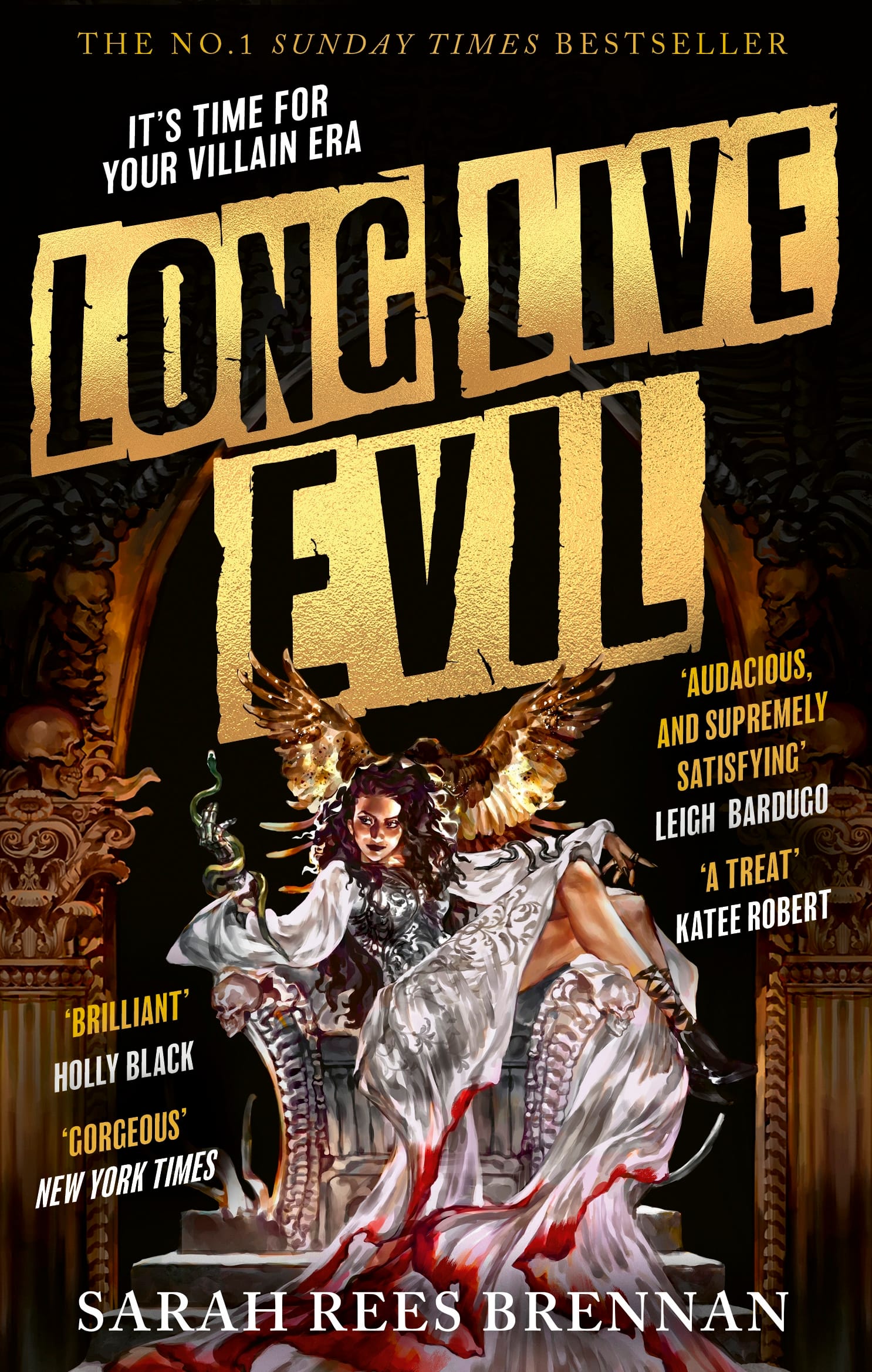
Author: Sarah Rees Brennan
Published: 2024
Target audience: Adults
“Nobody gets a happy ending, unless we steal one. We can do it. We’re villains. I’ll put this story right.”
As her whole life collapses, Rae still has her books. Stuck in a hospital bed and dying from cancer, Rae is offered a second chance: enter the world of her favourite book series, steal the Flower of Life and Death, and then she will be returned home, miraculously cured.
She is transported to the fantasy land of Eyam, home to the future Once and Forever Emperor - her favourite fictional character. However, Rae discovers that she’s not herself there, nor even the story’s heroine. Instead, she awakes in the body of Lady Rahela, the villainess in the Emperor’s tale and slated for execution in the morning.
Determined to seize control of her story, Rae must hatch a plan to assemble a crew of rogues, heist a magical flower, and re-write destiny. With villainess flair, assassins on her heels, and colourful minions in tow, Rae is ready for her villain era. And evil has never looked this good…
INTRODUCTION
Featuring audacious villainous plots, a bodacious wisecracking protagonist, and an unexpected musical number, ‘Long Live Evil’ is a lively adult fantasy novel from Irish author Sarah Rees Brennan and the first book in the ‘Time of Iron’ series. The story’s villainess isekai premise is fun and exciting, and I was keen to see how Rae would gather her rogues gallery and scheme her way to victory. There is an inherent appeal and intriguing ambiguity to stories that blur the line between hero and villain, and ‘Long Live Evil’ bursts onto the scene alongside contemporaries such as ‘Assistant to the Villain’ by Hannah Nicole Maehrer, ‘Dreadful’ by Caitlin Rozakis, and ‘How to Become the Dark Lord and Die Trying’ by Django Wexler.
This should make for a captivating read, but unfortunately ‘Long Live Evil’ is hampered by numerous characterisation and structural issues. The novel struggles to present Rae as a likeable protagonist with well-developed capabilities and traits for readers to become invested in. It also appears to lack an understanding of the basic tropes and thematic techniques that make isekai stories such an appealing and dominant genre. The storytelling does however improve across the course of the book, and its strengths and weaknesses can be examined through an analysis of the narrative in two halves.
THE SINS OF THE FIRST HALF
The core appeal of reincarnation isekai and villainess isekai stories are as power fantasy and revenge fantasy conduits. These stories are about overcoming powerlessness, rebuilding self worth, finding friends and allies, and building a better life while former abusers lose everything. While protagonists usually have insider knowledge (from being sent back in time, having read the book they now inhabit, supernatural aid, etc) it is only through their wits, empathy, and personal capabilities that they are able to change fate and prevail. After waking up as the villainess of a book series in ‘Long After the Ending’, Elena draws on her knowledge of modern dating and romance tropes to open a relationships counselling business and avoid her character’s prewritten downfall; Suho Kim from ‘The Greatest Estate Developer’ uses his experience as a Korean civil engineering student to overcome debt and danger in a medieval fantasy world; and after being killed by her cheating husband and toxic best friend in ‘Marry My Husband’, Jiwon Kang wakes up 10 years earlier and vows to live a happier life and pass her misfortune on to those who’ve wronged her. Protagonists in such stories start in a position of vulnerability, despair, and isolation, and their reincarnation isekai journey typically does not begin by choice. It is seen as a one last chance, a double-edge gift, and that’s what makes their journey compelling.
In comparison, Rae in ‘Long Live Evil’ has no particular skills or capabilities, and actively chooses to walk into Eyam because of nonsensical reasoning. A random lady turns up in in Rae’s hospital room and proclaims - without any proof - that Rae’s tumours have become untreatable, that Rae’s medical cost will impoverish her family, and she will still die anyway. Rae has no reason to believe this woman, yet illogically decides to take her word and enter into a magical bargain that no one else has returned from. This makes Rae look foolish, reckless, and lacking in critical thinking skills.
This trend unfortunately continues throughout the book, worsened by Rae’s poorly-established motivations and personality. She claims she wants to nab the magic flower to return home cancer-free to her sister, but her impulsive actions and blabbermouth work counterintuitive to these supposed goals. She comes across like an excited tourist who has no regard for anyone else, with short-sighted plans that only work because she is the main character. Ultimately, Rae does not feel like a real person. This is a shame, as Rae’s personal circumstances are acute and sympathetic, and should make for a layered, engrossing main character: She hates how weak she has become from cancer, is frustrated at no longer being able to protect her sister, and feels rightfully abandoned by her parents, cheerleading friends, and especially betrayed when her boyfriend and best friend hook up. Shaped by sisterly affection and helpless rage, ‘Long Live Evil’ has all the elements for a relatable and riveting protagonist, yet the execution is poor and unengaging.
Once in Eyam, Rae treats everyone like costumed characters at a theme park, making it is hard for readers to find the inhabitants interesting or worth paying attention to. Rae makes no effort to pass as Lady Rehela or blend in, with her every second line being modern slang or a pop culture reference. Her flippancy and lack of concern at being sentenced to death would make sense if she thinks everything is a dream, but Rae insists she is trying to survive and make it back to her sister. Rae’s casual dismissal of the Eyam’s laws and social customs make the fantasy world feel less believable, particularly as there are no adverse consequences for her acting erratically or waltzing through the palace like she isn’t a prisoner. She succeeds in converting Key and Emer to her side despite acting like a sugar-high child, and shortly after tricks the Emperor into thinking she can see the future by reciting forthcoming plot points from memory. Despite the novel’s attempts to present it as clever manoeuvring by Rae, these so-called ‘victories’ are not earned by any skill, wit, or studied knowledge on her part, and sets a precedent that she doesn't need to exert any effort to prevail. This undercuts narrative tension, negatively impacts Rae’s likability as a protagonist, and fails to give readers a reason to become invested in her story.
Rae also just won’t shut up about her boobs. There’s a fine line between body celebration and degrading objectification, and this novel does not navigate it well:
Click to reveal: A non-comprehensive list of quotes in the book's first half from the protagonist regarding her boobs
- "And I'm not padding this dress. Everything they say about Lady Rahela's...enormous tracts of land is true." (pg.33)
- "I'm top-heavy as a double-scoop ice-cream cone over here." (pg.34)
- My prophecy-giving mouth is up here. What, the chosen of the gods can't have fantastic tits?" (pg.54)
- She wasn’t used to baths in Eyam, where jasmine water, orange water, lemon water and rose water were sprinkled over her head and breasts from silver vases. (pg.74)
- "I am Lady Rehela Domitia, and I am burdened with glorious prophecy! Also a glorious bosom, but that's not relevant.” (pg.77)
- “…These boobs aren’t anatomically possible. I keep losing my balance.” (pg.104)
- Maybe she should have worn something else, but a high-necked dress would make Rahela’s assets obvious in a different way. (pg.147)
- …she found corsets entirely necessary to support wicked curves… Dressed thus, the scaffolding that heaved Rae’s bosom high was obvious. (pg.180)
- “Right? I have great hair, a great rack and a wealth of dark sarcasm. I’m basically the perfect woman.” (pg.186)
- “I mostly use my fan to cover the evil twins.” She made a gesture bosomward. “I call them Cruella and Maleficent.” (pg.192)
The novel attempts to present this as a comedic and palatable way of Rae revelling in experiencing being strong and healthy again after years of cancer laying waste to her body. It could also be interpreted as her rebelling against the rigid, patriarchal views of the fantasy world; Rae regularly critiques specific individuals along with Eyam’s wider societal demands of sexual purity and obedience from noble women, and for branding anyone deviating from this strict expectation as ‘deranged harlots’.
However, this portrayal falls flat as it is not her body, but Lady Rahela’s that Rae is inhabiting. Rae notedly views Rahela's body as not her own, but as something to have inconsequential fun with, asserting that ‘She could get the experience she missed out on. In a book, orgasms seemed far more certain than in reality. Rae could use the practice for when she got better, and went girl gone wild in collage. This wasn’t really her body: it wouldn’t count.’ Despite wondering what will happen to Rahela after Rae returns to the real world, Rae has no issues with considering using the body she is possessing for sex all while simultaneously degrading Rahela: ‘She felt dazed by desire, the mere fact of an eager ache between her thighs shocking. She'd believed she would never feel these impulses again. For so long her body seemed made for only pain. Apparently Lady Rahela's body was a harlot in the sheets and a harlot in the streets…She could be wanton, and blame Lady Rahela.’ Presented in this manner, Rae’s behaviour and views come across as hypocritical with unpleasant slut-shaming undertones and implications of non-consensual sexual intentions.
‘Love Live Evil’ also suffers from numerous structural issues. The world-building is overstuffed and exposited in ways that interrupt narrative flow. Yet simultaneously, it is woefully lacking in parting information that is comprehensible or actually relevant to Rae’s situation. It’s difficult for readers to ascertain if a particular line or phrase is meant to foreshadow a twist or reveal hidden character motivations, or if it’s just so poorly written that who knows what the author intended to convey. Furthermore, although Rae is the main point-of-view character, every few chapters features a different character’s perspective. While this technique allows for insights into details and events occurring beyond Rae’s awareness, many of these POV shifts don’t add anything new or beneficial to the story. The same information is repeated again and again in a haphazard way that becomes tiresome for the reader to keep track. There are story elements that kick the story into a fun new gear, only for new characters to be forgettable or frustratingly underdeveloped. The Cobra, for example, is a flamboyant, snarky spymaster with his own agenda and fascinating promise. Yet he has many of the same characterisation issues as Rae that makes him annoying, undercuts likability, and ultimately renders any narrative reveals less impactful.
However, after over 150 pages of barely-connected scenes lackadaisically slapped one after another with only vague promises of a payoff for slogging through, there comes a turning point that sees a marked improvement in characterisation, pacing, and narrative directions in the novel’s second half.
THE STRENGTHS OF THE SECOND HALF
The best part of ‘Long Live Evil’ is Rae’s personal guard and murder-happy minion, Key. A skilled former mercenary assigned to guard Lady Rahela before her execution, Key is easily persuade to join Rae’s quest for villainy at the promise of gold and violence (and maybe some praise). Key is an honestly great character. His personality is distinct and consistent, and his particular view on the world and people is complex, intriguing, and supported by a sympathetic backstory. Abandoned as a baby and struggling to see other people as ‘real’, Key is hilarious, irreverent, and proactive in driving the plot forward to make Rae’s ambitions possible.
Furthermore, Key makes the fantasy world of Eyam feel tangible. Instead of just being a vague backdrop that only exists when Rae is looking at it, Key’s antics and interactions provide a genuine, lived experience that presents Eyam as a land populated by numerous people from a plethora of backgrounds, difficulties, untouchable powers, and desperate poverty. His existence also fosters fascinating consideration for the shallow characterisation of minor side characters. Rae speculates that Key was only supposed exist for one scene before she knocked the original plot of course, noticing how his mouth was “made for twists, sneers and insincere smiles, but he looked slightly off when he grinned. Maybe the writer never actually gave him a real smile.” This raises intriguing questions about what a person would be like without the connections, beliefs, and motivations granted to main characters, and makes Key a magnetic, sympathetic serial killer whose journey you can’t help but get invested in.
This is by no means a claim that the second half is a bastion of good writing. The book continues to be rife with clunky, cringey scenes that adversely impact a reader’s suspension of disbelief, such as when Rae and the Cobra decide to perform a musical number at a royal ball as a distraction. The audience - comprised entirely of the upper echelons of an intolerant society who a) have never heard of musicals, b) look down on both characters as contemptuous, c) live with the regular threat of undead creatures attacking, and d) condemn any behaviours contrary to their rigid social expectations - upon seeing such a spectacle, these people inexplicably starts delightedly squealing “Evil!” and cheering. The incongruence undermines what is actually working in such scenes. The wordcraft and story structure continues to be in desperate need of editing, however Rae’s moments with Key at the novel’s midway point grants the narrative focus.
Through her interactions and responses to Key, Rae shows a depth of character and honest vulnerability that has been sorely needed, as well as improved discernment of people and events around her. In learning about Key’s past, Rae shares her own experiences with cancer and how it affected her relationships with friends and family. She confesses her fear, isolation, and powerless rage, and why she is fighting to get back to her sister. While many of these points have already been mentioned in the first half of the book, the delivery had felt tokenistic, not reflected in her actions, nor relevant to the particular scenes at play. Rae becomes a more defined, relatable character throughout the second half, and this hooks readers in as she kicks off her schemes.
The novel’s pacing and tension also improves. Immediately following Rae and Key’s pivotal conversation, the first half’s procession of meandering side quests converge to reveal Rae’s plan for getting the Flower of Life and Death.‘Long Live Evil’ finally stops vomiting world-building tidbits and proselytising about the value of stories, and instead concentrates on actually telling an engaging tale. There is a new focus on interpersonal conflict and rising tensions as characters hone in on their goal, only for adversaries rise to combat them. Characters are forced to consider what they want and who they will allow themselves to be, and in doing so push the narrative in directions that are fresh and intriguing. This coalesces with a momentum that make the final third driving, attention-grabbing, and leads to a climax that makes you wish the next book was already published to keep reading.
CONCLUSION
‘Long Live Evil’ is an imperfect book, but one that improves over the course of its tale. The final third was gripping and had me genuinely interested in its upcoming 2026 sequel, ‘All Hail Chaos.’ However, after ending on a high and putting the book down, it did not take me long to remember how exasperating the rest of the book had been. Upon reflection, this is not a book I want to revisit, nor a series I wish to continue reading. With such a fun premise and narrative potential, I’m disappointed ‘Long Live Evil’ didn’t undergo greater editing and polishing before being published. Long Live Mediocrity.
